




Giovanni Demio’s visionary talent and the dialogue between art and architecture.
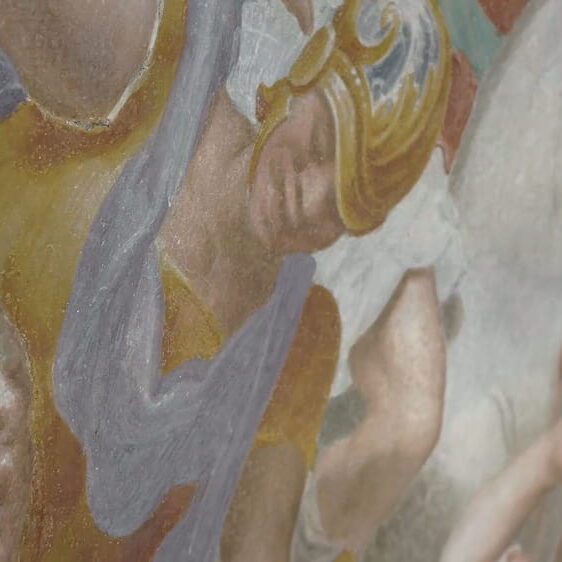
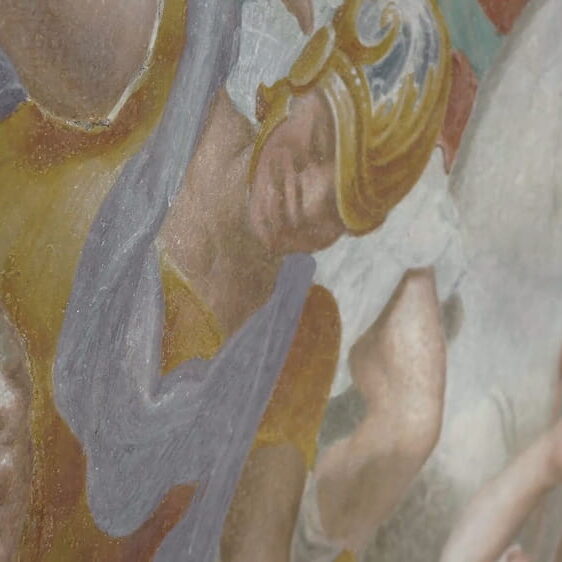

Giovanni Demio, born in Schio during the early decades of the sixteenth century, is the author of the frescoes in the square hall of Villa Thiene, painted between 1552 and 1553. As Barbara Rocco highlights, the artist arrived in Quinto fully mature in his craft, after a journey that had taken him through Veneto, Lombardy, and central and southern Italy, where he absorbed diverse artistic models and reinterpreted them with remarkable creative freedom.
The decoration of the vault, featuring the myth of Deucalion and Pyrrha at its centre and mythological scenes within the side medallions, summarizes this rich cultural background. Energetic figures, dramatic draperies, and monumental architectural settings reveal the influence of Giulio Romano and central-southern Italian artistic traditions, while also expressing Demio’s personal sensibility, which made him an original Mannerist painter admired by Andrea Palladio himself, who described him as a “man of most beautiful ingenuity.”
In Vittorio Sgarbi’s interpretation, Demio emerges as a “genius of the highest order” who remained on the margins of art historiography for a long time, partly due to the silence of Giorgio Vasari in The Lives. An independent and restless artist, he moved through the sixteenth century without fully embracing the canons of Classicism, developing a personal and intensely expressive style.
Sgarbi emphasizes his painting as one of “flesh and blood,” characterized by dense materiality, vibrant figures, and dramatic light. Through this perspective, Demio appears as an autonomous and modern voice within Mannerism, capable of engaging with the great masters of his time while maintaining his own visionary strength.
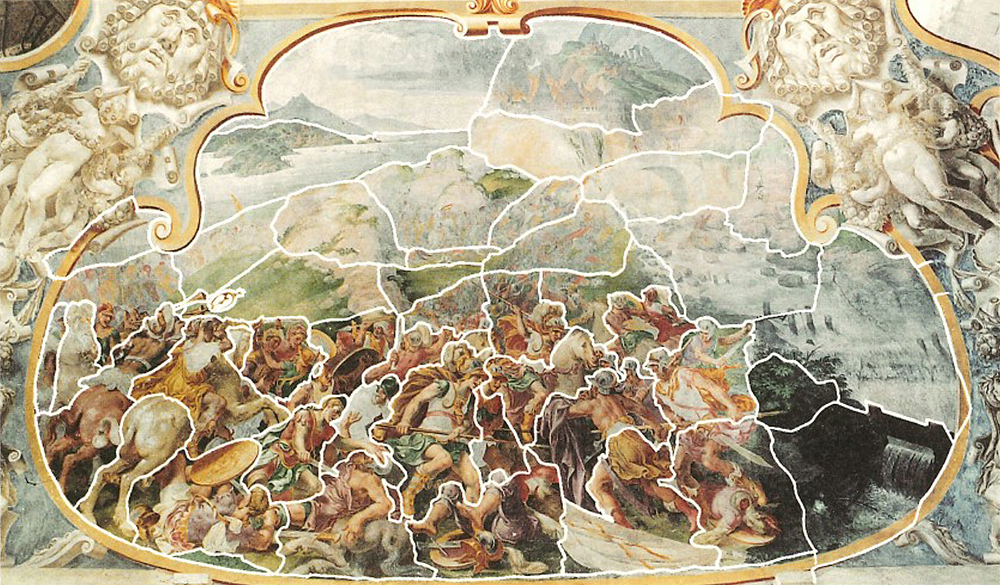
The graphic survey of the giornate—the daily plaster sections used in fresco painting—on the vault of the square hall at Villa Thiene, carried out by Renzo Benedetti and Monica Val, has made it possible to reconstruct Giovanni Demio’s working process with remarkable precision. Analysis of the portions of plaster painted each day clarified the chronological sequence of the scenes, beginning with the central panel depicting Deucalion and Pyrrha and continuing through the side medallions and monochrome decorations.
The study of overlaps and brushwork reveals a faster and more energetic execution in the battle scenes, where colour, movement, and a wealth of details heighten the narrative power of the composition.
The analysis of the giornate has therefore provided an accurate reconstruction of the execution sequence of Demio’s frescoes in the square hall of Villa Thiene. The battle scenes display a more rapid and dynamic application of paint, characterized by intense use of colour and strong narrative impact.
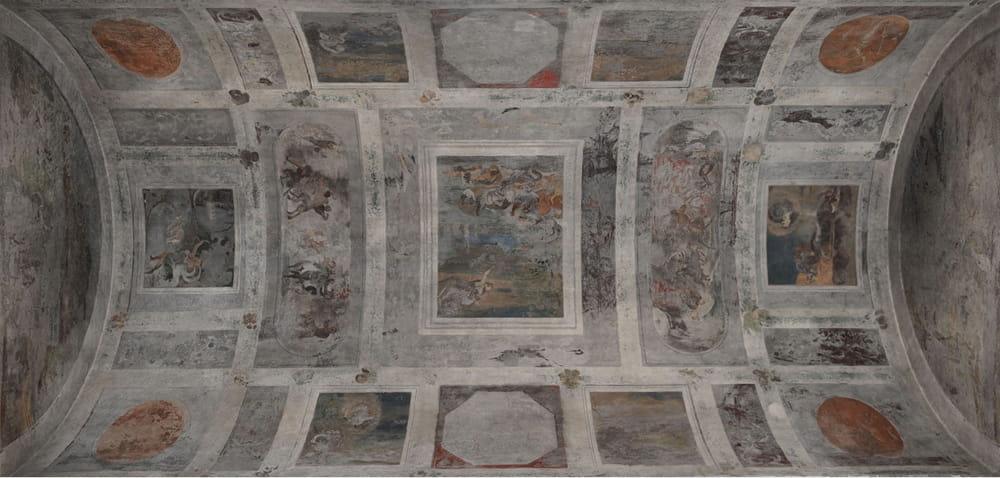
Inside Villa Thiene, the great pavilion vault (more properly known as a schifo vault) dominates the main hall with its imposing presence. Nearby, the Camerino, now used as the Mayor’s Chamber, preserves limewash paintings by Anselmo Canera and Bernardino India, important Venetian artists associated with Palladio’s building projects.
Here, the barrel vault is more than a structural element: it becomes a feature that harmonizes space, light, and decoration, transforming the room into a small masterpiece of sixteenth-century Venetian art.
The pavilion vault of the main hall and the barrel vault of the Camerino define the villa’s most representative spaces. The paintings by Canera and India unite architecture and decoration in an elegant example of Venetian Renaissance artistry.
Villa Thiene in Quinto Vicentino can be visited by reservation and was recently renovated with the addition of accessible pathways.
Cookie policy
Su questo sito utilizziamo strumenti propri o di terze parti che memorizzano piccoli file (cookie) sul tuo dispositivo. I cookie sono normalmente utilizzati per consentire il corretto funzionamento del sito (cookie tecnici), per generare rapporti sull’uso della navigazione (cookie statistici) e per pubblicizzare in modo adeguato i nostri servizi/prodotti (cookie di profilazione). Possiamo utilizzare direttamente i cookie tecnici, ma hai il diritto di scegliere se abilitare o meno i cookie statistici e di profilazione. Abilitando questi cookie, ci aiuti a offrirti un’esperienza migliore.